
One of the key infrastructure evolutions I’ve worked on was the transition from a traditional NGINX-based architecture to a more robust and scalable Istio service mesh. This change was driven by the need for better observability, enhanced security, and greater control over service-to-service communication within our Kubernetes cluster.
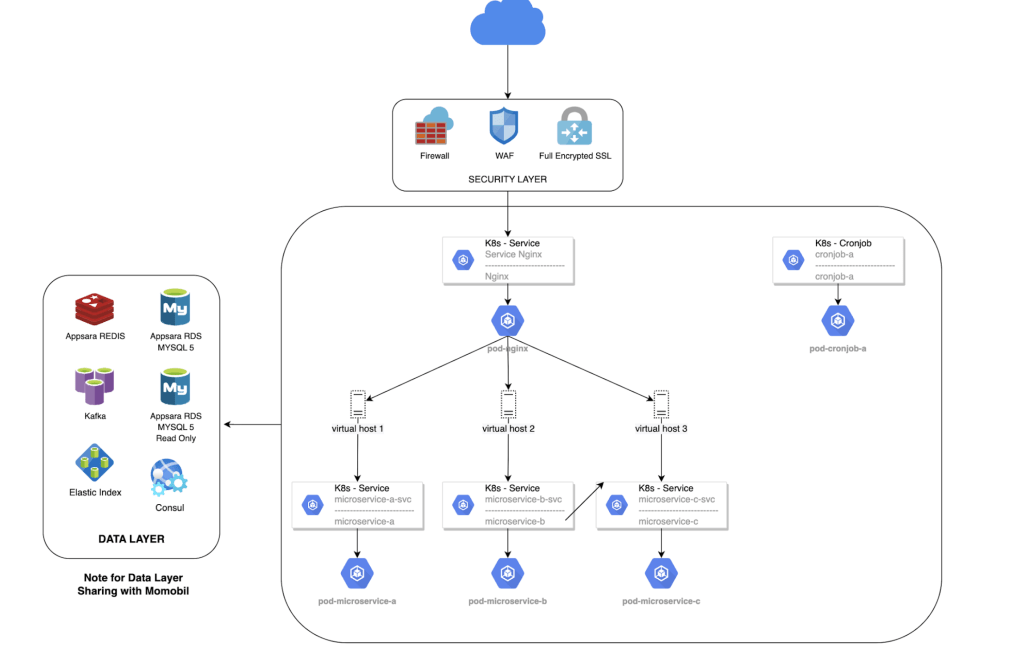
In the earlier setup, NGINX served as the API gateway and load balancer, managing incoming traffic and routing it to the appropriate services. This setup relied on conventional methods for monitoring, security, and scaling. The security layer was implemented through a combination of firewall, WAF, and SSL, while the services communicated through manually defined configurations. The data layer, which included Redis, MySQL, Kafka, and Elastic, was maintained separately and accessed directly by the services.
The new architecture introduced Istio as the central control plane for service-to-service communication. Instead of relying on NGINX, we now use Istio’s ingress gateway to handle incoming traffic. Istio also provides advanced routing, traffic splitting, observability, and security features out of the box. This transition allowed us to separate concerns more clearly into distinct layers: the security layer (firewall, WAF, SSL), the service mesh layer (Istio), and the data layer (Redis, MySQL, Kafka, Consul).

This transition also allowed for better integration with our existing Kubernetes-native deployments, enabling a more resilient and scalable microservices architecture.
 Even Owen